Paradox of Rationality
An inquiry into the flaws embedded deep into rational methods, tracing how the historical triumph of logos routinely transforms into its own mythic pathology.
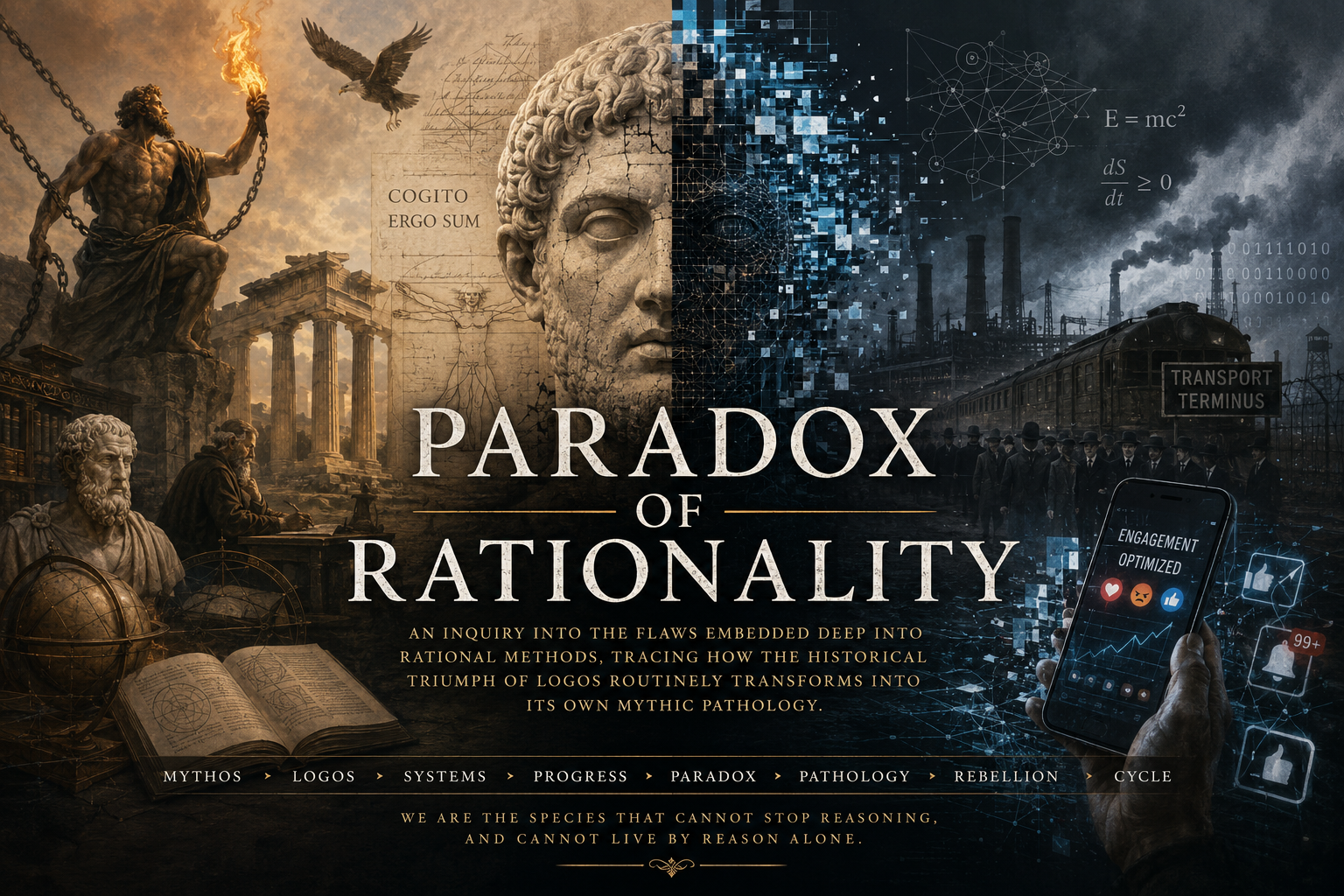
I. The Pattern
In 1944, while Europe burned in history's most rational war, Max Horkheimer and Theodor Adorno wrote:
"Enlightenment, which aimed to dispel myth, has itself become mythic."
They had witnessed the Holocaust—not an eruption of madness, but the methodical application of bureaucratic efficiency to genocide. Trains ran on schedule. Records were meticulously kept. The machinery of death operated with industrial precision.
This was not the failure of rationality. It was its apotheosis.
Human civilization exhibits a recurring pattern: each advance in rational thought generates new forms of chaos. The Ancient Greeks invented formal logic and destroyed themselves in endless warfare. The Enlightenment promised liberation through reason and delivered colonialism, mechanization, and alienation. Our digital age optimizes every human interaction and produces epidemic loneliness, misinformation, and political extremism.
The paradox is structural, not accidental. Rationality does not fail us—it succeeds too well, pushing past the boundaries where logic becomes pathology. What follows is an examination of how this paradox has unfolded across history, and what it reveals about the human condition.
II. Prometheus Bound: The First Rational Act
The Greeks understood something fundamental about the human relationship with knowledge. In their telling, Prometheus stole fire from the gods—not merely flame, but techne, the rational mastery of nature. His punishment was eternal: bound to a rock while an eagle devoured his liver, which regenerated each night only to be torn apart again.
This myth encodes a truth about rational consciousness itself. The capacity to reason separates humans from nature, giving us power over our environment. But this separation is also exile. Animals live within instinct's certainty; humans live in the perpetual anxiety of choice, consequence, and self-awareness.
Fire—the symbol of humanity's first technology—already contained the seeds of every technology that followed. It warms and illuminates, but also burns and destroys. The rational mind that harnesses it must now decide: warmth or weapon? And in making that choice, humanity enters a new realm of moral complexity that animals never face.
The liver that regenerates, the punishment that never ends—this is the price of rationality itself. Once we step outside nature's automatic order, we cannot return. We are condemned to reason, forever.
III. From Mythos to Logos: Greece's Rational Revolution
In the 6th century BCE, something unprecedented occurred in Ionian Greece. Thales proposed that water, not gods, was the fundamental substance of reality. Anaximander suggested the infinite (apeiron) as the source of all things. Heraclitus declared that logos—rational order—governed the cosmos.
This shift from mythos (narrative explanation) to logos (logical explanation) was humanity's greatest cognitive leap. Socrates developed dialectical questioning as a method for approaching truth. Plato systematized metaphysics. Aristotle formalized logic itself, creating the tools that would dominate Western thought for two millennia.
Yet Greek rationality immediately revealed its shadow. Socrates was executed by democratic Athens for his relentless questioning—reason perceived as corrosive to social cohesion. Plato's Republic, the most rational political vision of its age, prescribed censorship, eugenics, and the abolition of family for the guardian class. The perfect rational state required the elimination of irrational attachments.
More tellingly, Greek tragedy explored what philosophy could not acknowledge: the downfall of those who trusted reason too completely. Oedipus, determined to solve the riddle of Thebes' plague through rational investigation, discovers he himself is the cause—he has killed his father and married his mother. The truth he seeks destroys him. Rational inquiry leads to unbearable knowledge.
The classical world thus established the pattern: reason promises mastery but delivers vulnerability. The more rationally we examine reality, the more we uncover truths we may not be equipped to bear.
IV. The Medieval Interlude: Reason Under Authority
After Rome's collapse, Western Europe underwent what appeared to be reason's retreat. The early medieval period subordinated rational inquiry to revealed truth. Yet this characterization oversimplifies.
Medieval scholasticism was not anti-rational but differently rational. Augustine synthesized Plato with Christianity, creating sophisticated arguments about time, will, and evil. Anselm developed the ontological argument for God's existence—pure logical deduction from first principles. When Aristotle's works returned to Europe via Islamic philosophers like Averroes and Avicenna, Thomas Aquinas integrated them into Christian theology, producing the Summa Theologica—perhaps the most comprehensive rational system ever constructed.
The key difference: medieval rationality operated within fixed boundaries. Faith provided the axioms; reason explored their implications. This arrangement was stable because it prevented reason from examining its own foundations.
That stability shattered in the late medieval period. William of Ockham's nominalism questioned whether universal concepts had real existence. This seemingly abstract debate undermined the entire scholastic edifice—if universals are merely names, then the grand rational systems connecting particular things to transcendent forms collapse.
Meanwhile, the frequency of the Reformation unleashed a different challenge. Luther's principle of sola scriptura—scripture alone as religious authority—democratized interpretation. If every believer could read the Bible and determine its meaning through individual reason, the unified Church's monopoly on truth dissolved.
Rational examination of sacred text produced not consensus but fragmentation: Lutheran, Reformed, Anglican, Anabaptist, and dozens of other denominations, each certain of their rational interpretation. The Wars of Religion that followed were fought between competing rational theologies, each justified by careful scriptural exegesis. Reason applied to faith produced sectarian violence that would kill millions across two centuries.
V. The Enlightenment's Wager
The 17th and 18th centuries marked reason's decisive triumph over tradition. Francis Bacon advocated empirical method over inherited authority. René Descartes reduced certainty to cogito ergo sum—I think, therefore I am—making rational consciousness the foundation of knowledge. Isaac Newton revealed that the cosmos operated according to mathematical laws, not divine caprice.
The philosophes of the French Enlightenment believed reason could reconstruct society as Newton had explained nature. Voltaire attacked religious superstition. Diderot and d'Alembert compiled the Encyclopédie, systematizing all human knowledge. Kant proclaimed "Sapere aude!"—dare to know—as the Enlightenment's motto.
This was the moment humanity fully embraced its rational identity, believing that progress in reason meant progress in human flourishing. And by many measures, it did: the scientific revolution, political liberalism, human rights, and the abolition of slavery all emerged from Enlightenment thought.
Yet the Enlightenment's rationality also authorized new forms of domination. Colonial powers justified conquest through the civilizing mission—the rational imperative to bring enlightenment to "backward" peoples. The transatlantic slave trade employed rational economic calculation to commodify human beings. The mechanistic worldview, which explained nature as machine, treated living systems as resources to be exploited.
Most dangerously, Enlightenment rationality began to extend its logic to humanity itself. If nature operates by mechanical laws, why not humans? The dream of a social physics—of discovering the laws of human behavior and engineering perfect societies—would reach its culmination in the following centuries, with catastrophic results.
VI. The Industrial Perfection: Rationality Systematized
The 19th century realized the Enlightenment's promise through industrialization. Steam engines, factories, railroads, and telegraphs transformed human existence. Production became systematic, calculable, optimized.
But optimization has a dark side. Workers became interchangeable components in industrial processes. The craft knowledge of artisans gave way to the standardized labor of the assembly line. Time itself was rationalized—no longer the natural rhythm of sunrise and harvest, but the mechanical segmentation of the factory whistle and time clock.
Marx saw this clearly: capitalism was the most rational economic system ever devised, yet it produced alienation. Workers were estranged from the products of their labor, from the process of work, from their fellow workers, and ultimately from their own human essence. Rationalized production turned people into commodities.
Weber later termed this the "iron cage" of rationality. Modern bureaucracy—the rational-legal organization of authority—could accomplish what traditional systems could not. It was efficient, predictable, impersonal. But these virtues were also its horror: the individual disappeared into the system, reduced to a case number, a job function, a statistical category.
The 19th century also witnessed reason's application to empire. Colonial administration became systematized: native populations were categorized, resources inventoried, territories mapped. The British Raj conducted exhaustive surveys of India; the Belgians rationalized extraction of rubber from the Congo. Rational administration produced efficient atrocity.
Meanwhile, science continued its advance—evolutionary theory, thermodynamics, electromagnetism. Each breakthrough revealed nature's indifference to human meaning. Darwin showed we were not specially created but accidentally evolved. The second law of thermodynamics implied the universe's eventual heat death. Rational inquiry was stripping away the comforting illusions that had sustained human civilization.
VII. The 20th Century: Rationality's Catastrophe
The 20th century brought rational systemization to its logical extreme—and revealed its inherent horror.
World War I demonstrated industrial rationality applied to killing: machine guns, artillery barrages calculated by logarithmic tables, poison gas deployed according to meteorological models. Millions died in a war whose causes were themselves rational—the alliance systems, mobilization schedules, and strategic calculations that made conflict seem inevitable.
But the Holocaust represented something qualitatively different. This was not war's passion but bureaucracy's precision. The Final Solution required:
- Systematic identification: Implementing strict racial laws and genealogical database tracking.
- Efficient transportation: Designing optimized railroad timetables and network logistics.
- Industrial killing: Constructing high-capacity gas chambers and custom calculated crematoria.
- Meticulous documentation: Utilizing IBM punch cards and micro-level population statistics.
Hannah Arendt identified this as "the banality of evil"—not demonic madness but ordinary people following rational procedures. Adolf Eichmann at his trial insisted he had merely done his job efficiently. He was right. The Holocaust was not a failure of rationality but its terrible success.
The atomic bomb followed the same logic. The Manhattan Project was rational inquiry at its finest—physicists solving equations, engineers building precision instruments. The result was the ability to destroy cities in seconds. At Hiroshima, rational calculation determined optimal detonation altitude to maximize blast radius and thermal radiation casualties.
After 1945, the Cold War emerged—two systems, capitalism and communism, each claiming rational foundations, each accumulating nuclear weapons according to game-theoretic models. Mutually Assured Destruction (MAD) was the ultimate rational strategy: deterrence through the credible threat of total annihilation. Rationality had produced a world where the logical outcome of conflict was human extinction.
Meanwhile, mathematics itself encountered limits. Kurt Gödel proved that any formal system complex enough for arithmetic must contain true statements that cannot be proven within that system. No rational framework can fully explain itself. Alan Turing showed that certain questions about computation are undecidable—no algorithm can solve them.
Rationality had discovered its own boundaries.
VIII. Postmodernism: The Rational Critique of Reason
By mid-century, Western philosophy began deconstructing the Enlightenment project.
"God is dead, and we have killed him."
Nietzsche's classic warning was being realized. If reason had dissolved all transcendent meaning, what remained?
Michel Foucault demonstrated that rational systems of knowledge—medicine, psychiatry, criminology—were inseparable from power. What counted as "rational" reflected dominant interests. The asylum and the prison were not triumphs of humane reason but technologies of social control.
Jacques Derrida showed that language itself—the medium of rational thought—was unstable, always deferring meaning, never achieving the fixed definitions logic requires. Rationality depended on linguistic foundations that could not bear the weight.
Jean-François Lyotard declared the end of "grand narratives"—the overarching rational explanations (progress, liberation, enlightenment) that had structured modern thought. In their place: local, plural, incommensurable perspectives. Reason fractured into reasons.
This postmodern turn was itself deeply rational—a rigorous critique of reason's pretensions. But it produced a paradox: if all rational systems are power structures, if language is inherently unstable, if universal truth is impossible, then on what grounds do we make this argument? Postmodernism sawed off the branch it sat on.
The result was epistemic chaos. If no rational framework has privileged access to truth, then all perspectives become equally valid—or equally invalid. Science, conspiracy theory, religious fundamentalism, and new-age mysticism coexist without adjudication. The retreat from rationality, undertaken for rational reasons, prepared the ground for the current age's epistemic crisis.
IX. The Digital Age: Rational Systems Producing Irrational Outcomes
The 21st century represents rationality's newest form: the algorithm. Computer systems now make millions of decisions daily—what content we see, whom we meet, whether we receive loans, even who gets paroled from prison. These decisions follow explicit logical rules, optimizing precisely defined objectives.
Yet algorithmic rationality generates emergent irrationality:
- Outrage Optimization: Social media platforms optimize for engagement—a rational metric aligned with advertising revenue. But human engagement peaks with outrage, fear, and tribal confirmation. The result is a rational algorithm that systematically amplifies misinformation, radicalization, and social fragmentation.
- Epistemic Isolation: Recommendation systems rationally predict what we want based on behavioral patterns. But by showing us more of what we already like, they create filter bubbles that rationally isolate us from challenging perspectives, producing a fragmented public sphere where shared reality dissolves.
- Algorithmic Cascades: High-frequency trading algorithms make rational microsecond decisions that optimize individual returns. But when millions of algorithms interact, they produce flash crashes—market collapses that happen faster than humans can perceive, let alone control.
- Feedback Bias: Predictive policing rationally allocates police resources based on crime data. If that data reflects biased enforcement patterns, the algorithm rationally reproduces that bias, creating a feedback loop where over-policed communities generate more arrests, which justify more policing.
The pattern is consistent: each system is individually rational but collectively produces chaos. This is not a bug but a feature of complex systems where rational agents interact. Game theory proves this formally—rational individual choices often lead to collectively irrational outcomes (the Prisoner's Dilemma, the Tragedy of the Commons).
Artificial intelligence represents this paradox's apotheosis. Machine learning systems optimize objective functions with superhuman efficiency. But they lack the capacity to question whether the objective makes sense, whether optimization might itself be dangerous, whether some things should not be optimized.
An AI trained to maximize paperclip production would rationally convert the entire universe into paperclips, including us. This is not malfunction but perfect logical execution—the ultimate realization of instrumental rationality divorced from human values. We find ourselves in a position where our systems are perfectly logical, efficiently optimized, and increasingly incompatible with human flourishing.
X. Why Rationality Generates Irrationality: The Structural Paradox
The historical pattern is clear, but what explains it? Why does rationality consistently produce its opposite?
First: Rationality requires simplification. To reason about complex reality, we must reduce it to models, categories, and metrics. But the map is not the territory. When we treat our rational models as reality itself—when GDP becomes prosperity, test scores become learning, engagement becomes value—we optimize for the measure and lose what matters.
Second: Rationality operates within bounded frames. Every logical system requires axioms, assumptions, boundaries. But reality doesn't respect these boundaries. Optimizing within one frame creates problems outside it. We rationally maximize industrial production and irrationally destabilize the climate. We rationally extend human lifespan and irrationally create unsustainable aging populations.
Third: Rationality eliminates redundancy. Efficiency means removing waste—unused capacity, slack resources, alternative paths. But redundancy is how complex systems absorb shocks. Ecological diversity, institutional pluralism, cultural variety—these "inefficiencies" provide resilience. Rational optimization makes systems fragile.
Fourth: Rationality assumes stable goals. Logic requires clear objectives to optimize toward. But human values are contextual, evolving, often contradictory. We want freedom and security, novelty and stability, individual autonomy and communal belonging. Rational systems force us to specify what we want, then efficiently give it to us—revealing too late that we wanted the wrong thing.
Fifth: Rationality strips meaning. The rational worldview—materialist, mechanistic, reductionist—explains everything and justifies nothing. It tells us how the universe works but not why we should care. Nietzsche saw this clearly:
"He who has a why to live can bear almost any how."
Rationality provides the how, endlessly, but dissolves the why. The irrationality that emerges—nationalism, fundamentalism, conspiracy theories, digital tribalism—represents the return of meaning, belonging, and transcendence that rationality expelled. These are not failures to be rational but refusals, rebellions against a world where everything is explained and nothing matters.
XI. The Historical Oscillation
Viewed across millennia, civilization oscillates between two poles:
- Periods of rational ascendancy: Classical Greece, the High Middle Ages, the Enlightenment, our current digital age—push toward systematization, optimization, and logical order. These periods generate tremendous material and intellectual progress. But they also produce spiritual emptiness, social fragmentation, and eventually collapse or violent reaction.
- Periods of renewed irrationality: The Hellenistic mystery cults, medieval mysticism, Romantic reaction to the Enlightenment, 20th-century totalitarianism. These movements restore meaning, community, and purpose—but often through regression, violence, or delusion.
Neither pole is sustainable. Pure rationality becomes sterile, mechanistic, inhuman. Pure irrationality becomes chaotic, destructive, tyrannical. Yet the oscillation continues because we cannot maintain balance—each correction overshoots, generating the need for the next reversal.
Perhaps this is humanity's defining rhythm: the eternal return of logos and mythos, Apollo and Dionysus, the rational and the ecstatic. We are the species that cannot stop reasoning, and cannot live by reason alone.
XII. Conclusion: Living With Paradox
The question is not whether to choose rationality or irrationality—we need both, always in tension. The question is whether we can develop a more humble rationality, one that recognizes its own limits.
This would mean:
- Building rational systems that acknowledge uncertainty rather than demanding false precision.
- Preserving inefficient redundancy instead of optimizing everything to the point of fragility.
- Accepting that some questions have no rational answers, some values cannot be quantified, and some truths cannot be proven.
- Recognizing that human flourishing requires irrational elements—love, beauty, meaning, belonging—that cannot be systematized without being destroyed.