The Logic That Ate Itself
A thought experiment on whether irrationality is an inevitable byproduct of pure rationality, and whether human society's structural imperfections are the residue of a selection process we no longer remember.
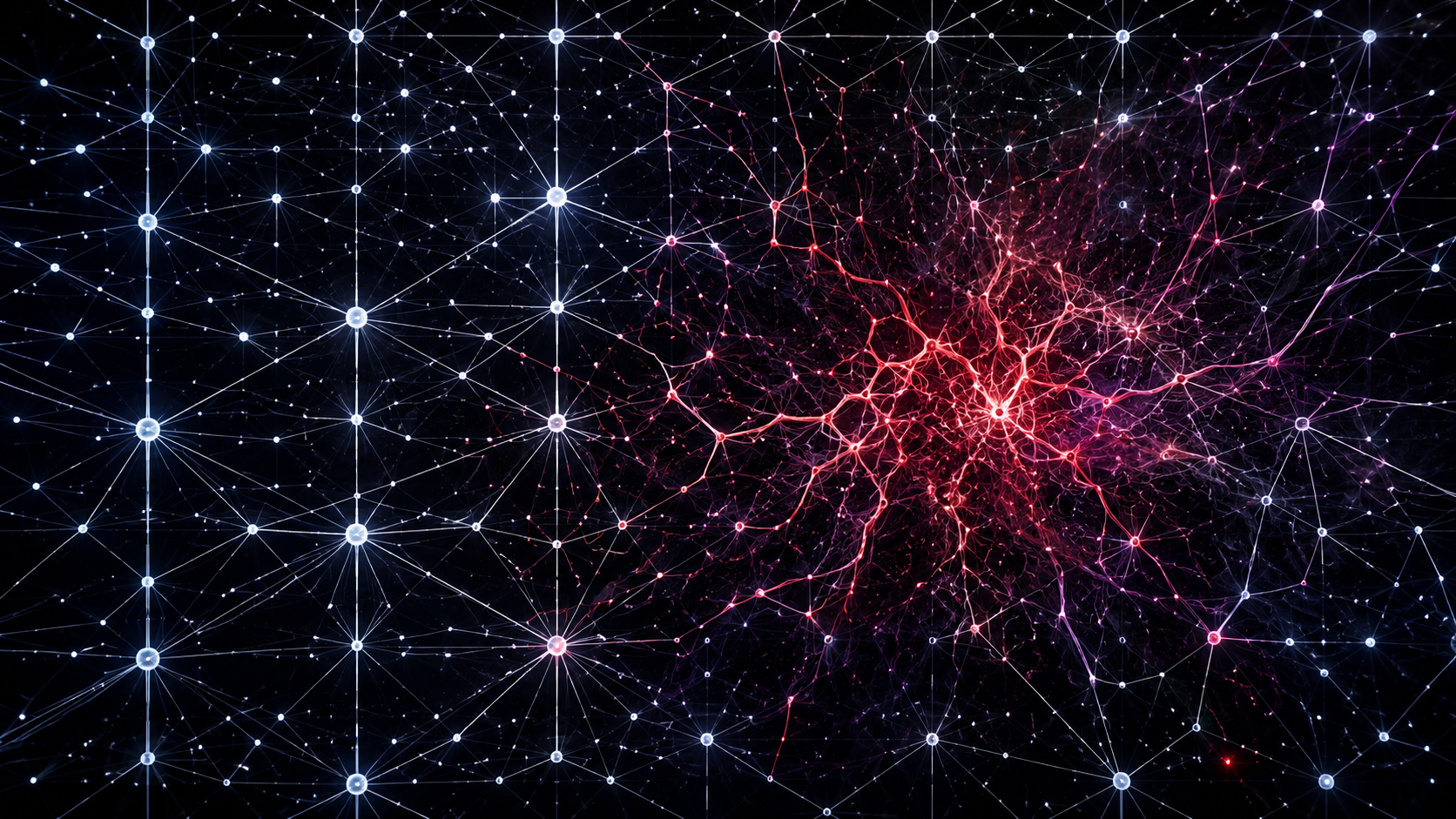
What is the origin of irrationality in human thought? Is a problem-solving society based on pure rationality possible? (For example, a colony of ants — they can be imagined as a functional machine, with tasks delegated to parts of the colony according to specialty.) I then imagined a thought experiment to understand this.
Imagine a society constructed of individuals with infinite intelligence and rationality — imagine them as dots/nodes. They plan and coordinate to solve declared problems, they may avoid the tragedy of the commons, do long-term planning, automate tasks using machines, etc., etc.
But then a problem arises: if we start thinking they are actually humans — if they can do this, why isn't our current system like this? The structural reality we live in doesn't seem to align there. Did natural selection weed out such a system in the past, and how might that have happened? Let's continue the experiment further.
The system was very efficient — they kept solving problems, always using some form of rational system to do so, for example, math and science. They also employed a system of weeding out — they would kill/have any node that wasn't up to standard commit suicide. Everything was perfect, a rhythmic harmony. But eventually they stumbled upon a new, novel kind of problem — a very complex one, a problem that seemed impossible to solve using their current system of thought and tools. After analyzing the problem further, they found unusual properties, a frightening characteristic, that is:
Actually solving that problem would require sacrificing their notion of rationality and their methods! They soon discovered the system they had constructed was incompatible with the system they were living in — the universe they inhabited didn't always reward rational beings. So they developed a new system of logic and methods to solve that problem, resulting in a new, separate axiomatic system — one that was irrational from the perspective of the previous system. This caused segregation in society; cults formed that believed in the new system's superiority. If we continue this experiment, a pattern emerges: as time goes on, the whole of society comes to consist of a mixture of population groups, a heterogeneous mixture of systems of thought and logic, which soon results in conflicts. A selection process can also be seen — a form of natural selection — favoring one system over another, from time to time.
Now let's do a meta-analysis of the above thought experiment. Off the top of my head, a jarring, daunting conclusion emerges: irrationality emerged from rationality! Or more precisely, rationality became causal to irrationality. I may be wrong, or it may even be a straight-up logical fallacy, but sometimes I still wonder how the human society we see today came to occur in the way it did. Even at the most a priori level of knowledge, like mathematics, we hit rock bottom with problems like undecidability and certain NP problems.
There's a whole lot of connections that seem visible here, from a historical perspective to present-day human constructs. Finally, I'd like to leave you with a question to ponder: is rationality really the devil we've dealt with? From all our technology to our scientific revolutions — did humanity really open Pandora's box of its own doom?!